 |
|
2026 NIST Golf Association Rules of Play
Revised: March 20, 2026 (see changes)GENERAL
Activities of the GA shall be governed by the USGA Rules except for the additional allowances below. Also note local rules printed on the scorecard.
[Note: The USGA rules for medal play shall govern.]
LOST BALL
Drop ball within two club lengths of the point where the ball was estimated to be lost, but not nearer to the hole or play from the previous point of play. One stroke penalty.
MERCY RULE
A player should pick up when PAR + 6 is reached on any hole.
UNPLAYABLE LIE
USGA rule 19 applies. One stroke penalty.
Note: Relief for a plugged ball, i.e., a ball in its own pitch mark, is allowed only in the closely mown grass through the green (e.g., the fairway). Reminder: Any ball found outside a penalty area can be declared unplayable.
A ball in a bunker may also be declared unplayable (see below).
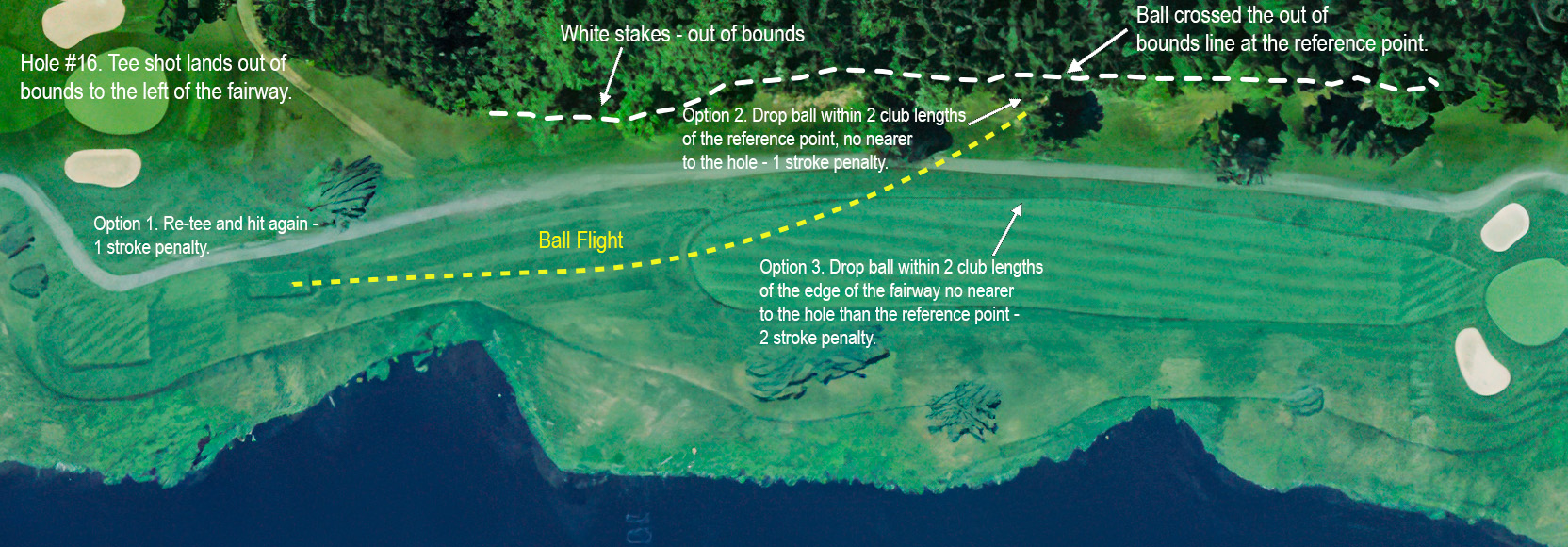
OUT-OF-BOUNDS (white stakes)
Drop ball anywhere within two club lengths of the reference point where the ball crossed the boundary, but not nearer to the hole. One stroke penalty.
Note: In the case where the ball position is beyond the green, "not nearer to the hole" can be modified by, "or not more than 2 club lengths from the point where the ball crossed the boundary of the course.
Note: In the case where 2-club lengths from the reference point is in a tall grass area, the reference point is where the ball entered the tall grass.
WATER - CROSSING PENALTY AREA (yellow stakes)
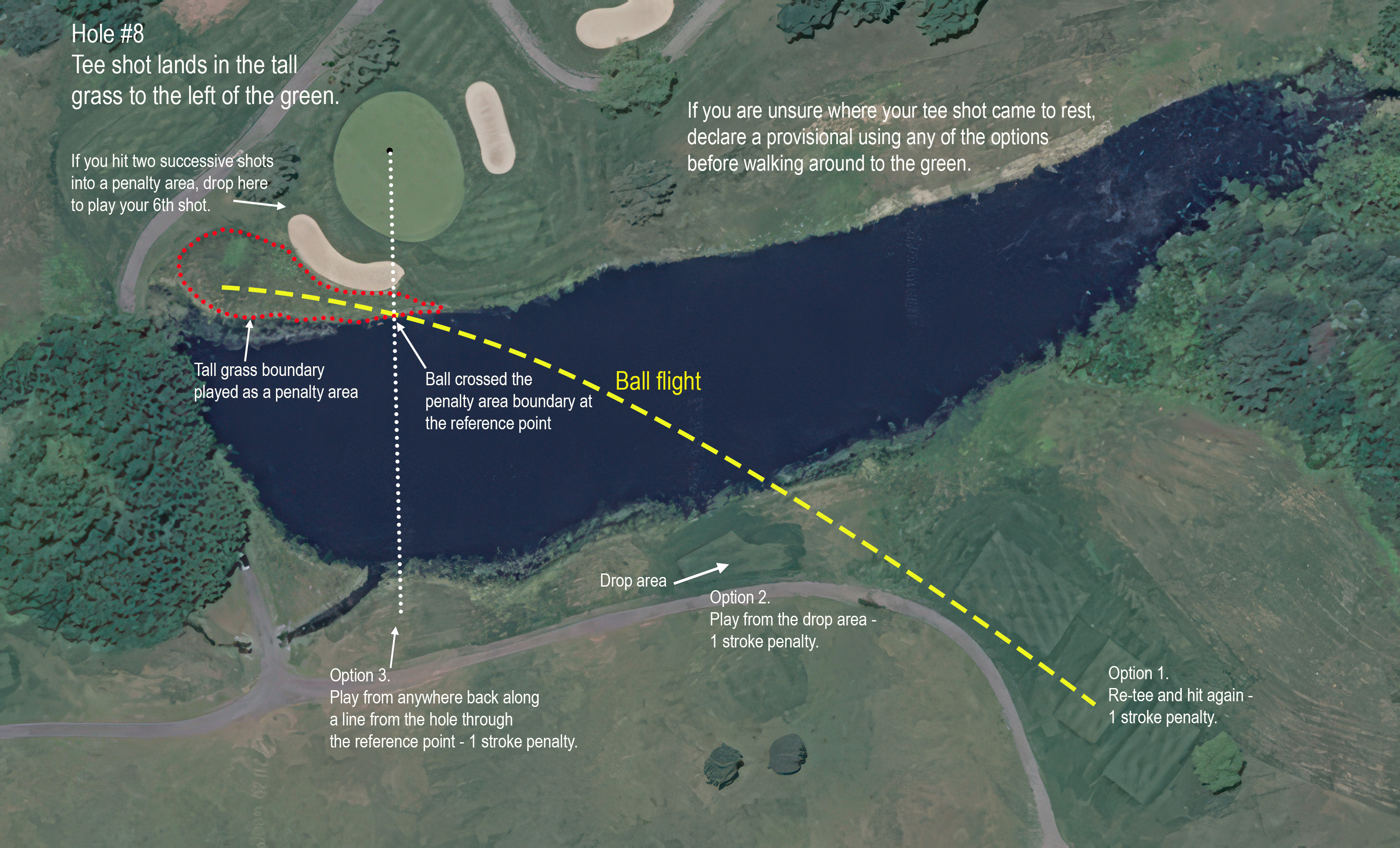
When a ball is hit into a crossing water penalty area, USGA rule 17 applies, except as follows. If two consecutive balls are hit into a crossing water penalty area, the player may drop the ball within 2 club lengths of the water on the other side. For example, the player now lies 5 hitting 6 (1 in, 2 out, 3 in, 4 out, 5 across) when the first stroke was from the teeing ground. The player has the option to drop a ball behind the water penalty area, keeping the point at which the original ball last crossed the margin of the water penalty area directly between the hole and the spot on which the ball is dropped, with no limit to how far behind the water penalty area the ball may be dropped.
WATER - LATERAL PENALTY AREA (red stakes)
When a ball is hit into a lateral water penalty area, USGA rule 17-d.(3) applies. When a ball is hit into a lateral penalty area, a ball is dropped outside the water penalty area (with a one stroke penalty) within 2 club lengths of 1.) the point where the original ball last crossed the margin of the water penalty area or 2.) a point on the opposite margin of the water penalty area equidistant from the hole, and in both instances not nearer to the hole than the point where the original ball last crossed the margin of the water penalty area. The player has the option to hit from the original position rather than using the 2 club lengths rule. The player has the option to drop a ball behind the water penalty area, keeping the point at which the original ball last crossed the margin of the water penalty area directly between the hole and the spot on which the ball is dropped, with no limit to how far behind the water penalty area the ball may be dropped.
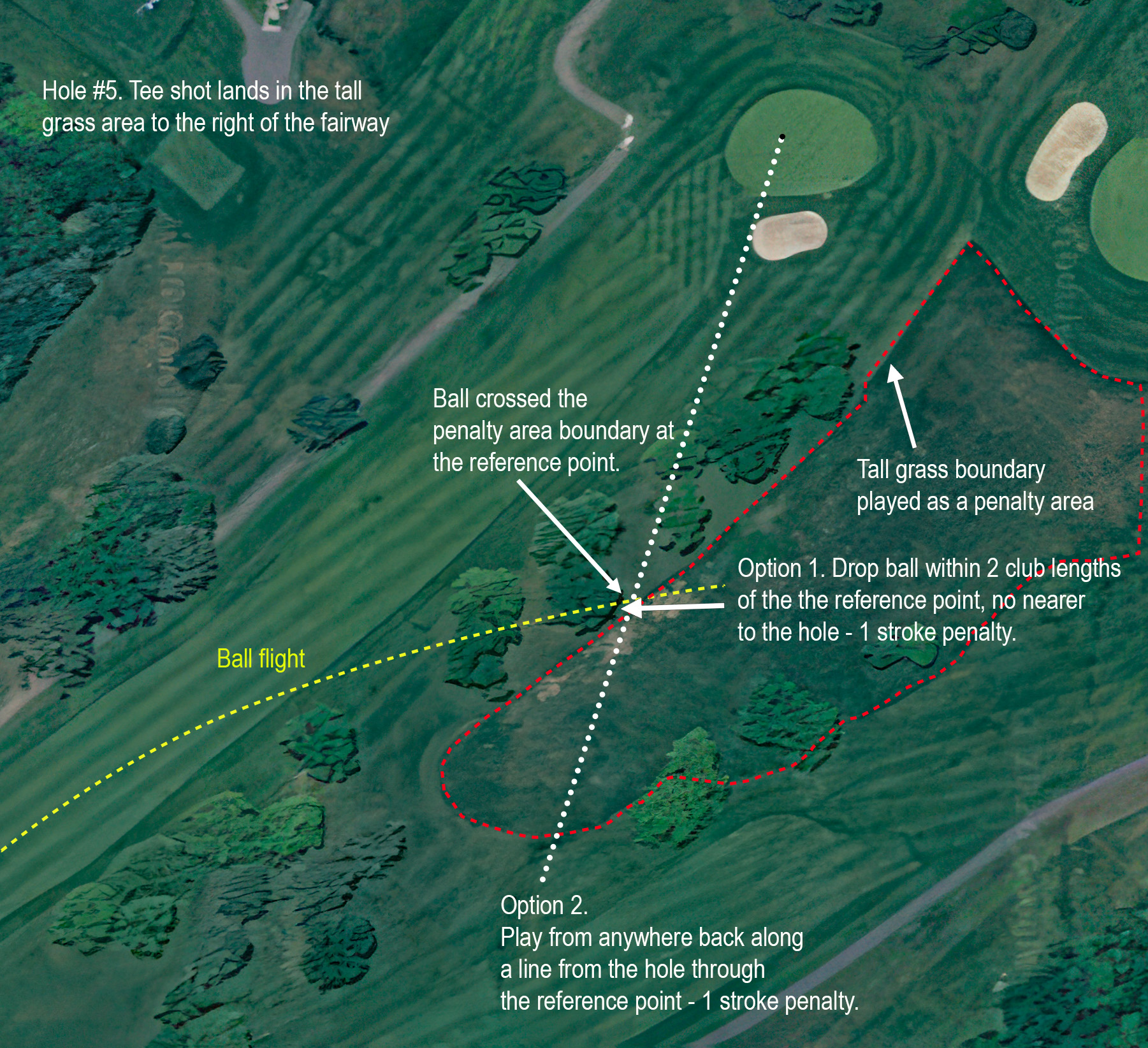
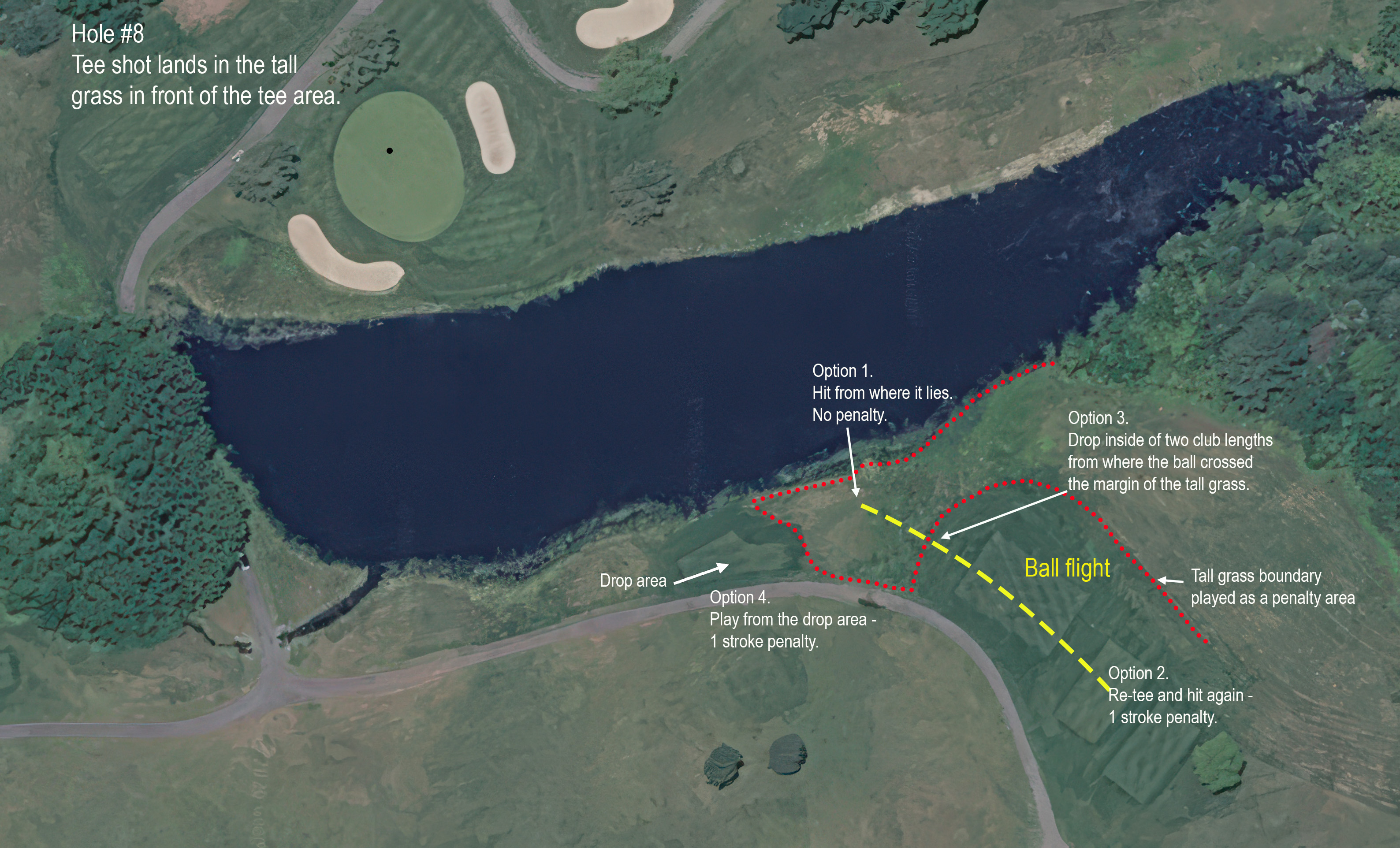
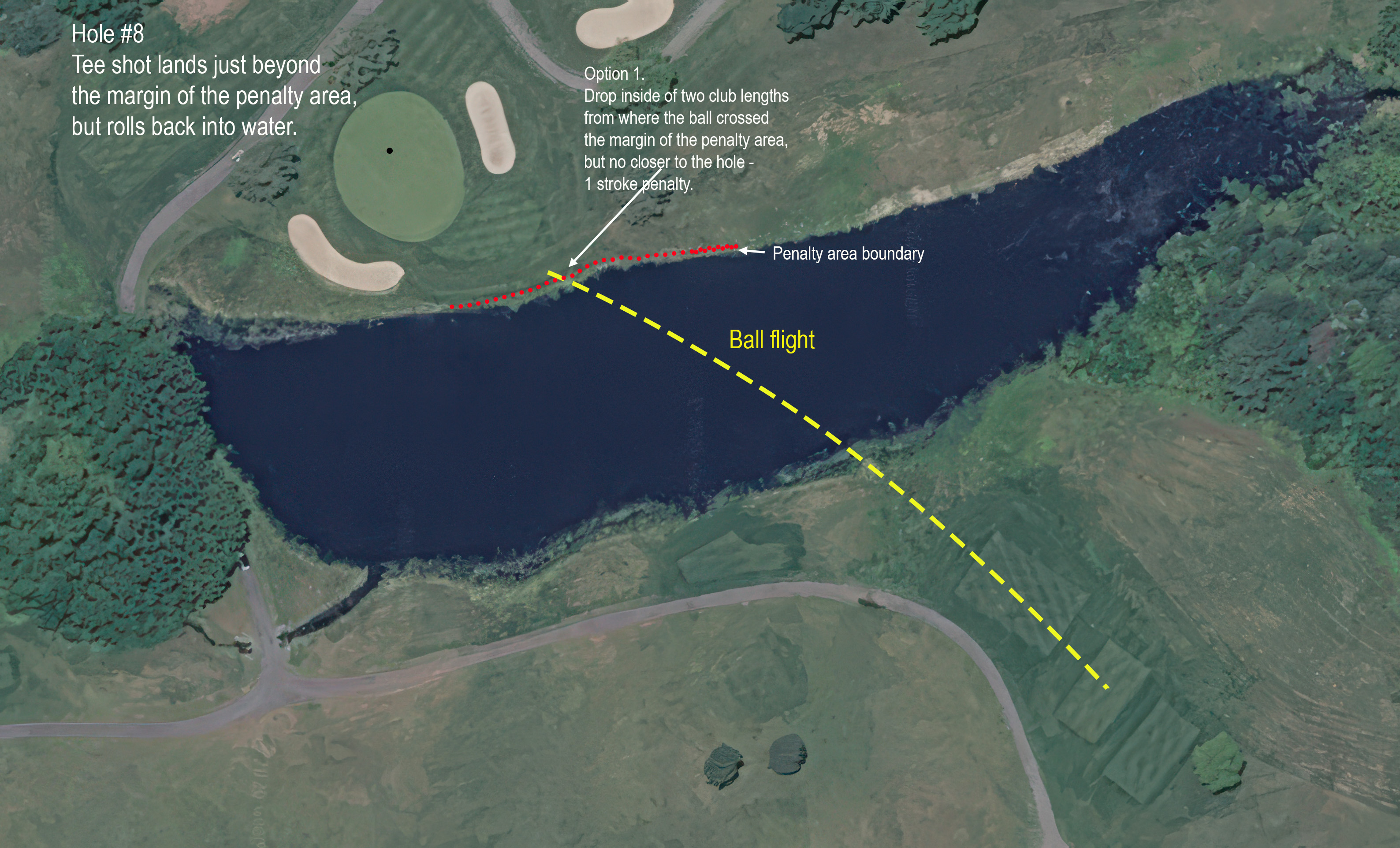
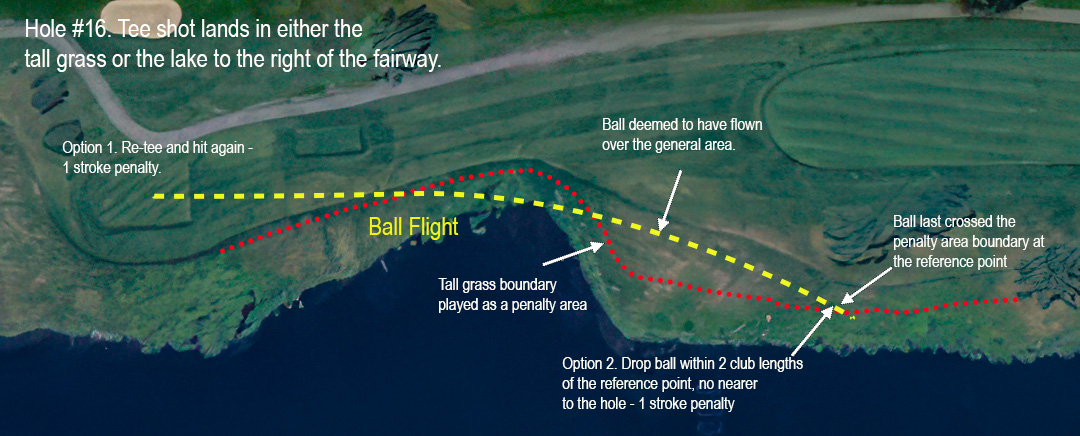
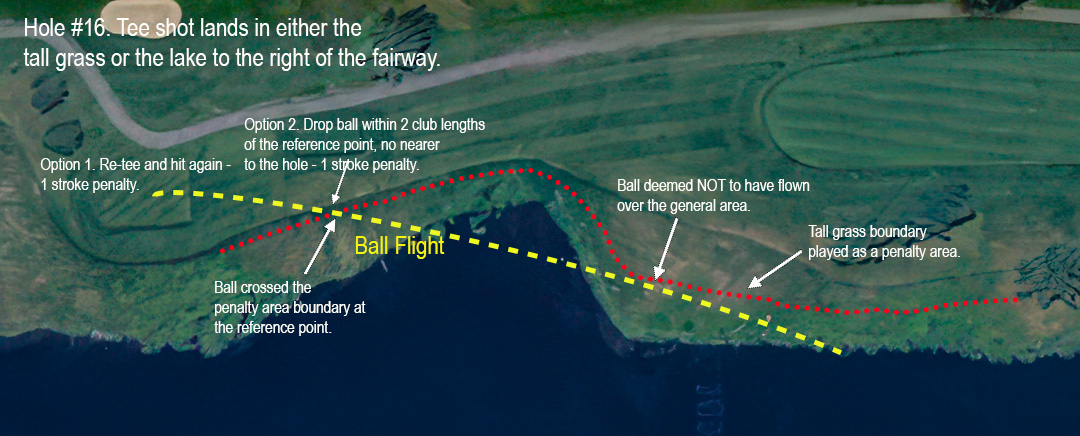
TALL GRASS - TREATED AS A LATERAL PENALTY AREA (no stakes) See examples below
Tall grass penalty areas are areas where the grass is taller than rough and the grass is unmown. These areas are not marked and the opposing player must agree when this rule is applied. When a ball is hit into a lateral tall grass penalty area, USGA rule 17d.(3) applies. When a ball is hit into a lateral penalty area, a ball is dropped outside the tall grass penalty area (with a one stroke penalty) within 2 club lengths of 1.) the point where the original ball last crossed the margin of the tall grass penalty area or 2.) a point on the opposite margin of the tall grass penalty area equidistant from the hole, and in both instances not nearer to the hole than the point where the original ball last crossed the margin of the tall grass penalty area. The player has the option to hit from the original position rather than using the 2 club lengths rule. The player has the option to drop a ball behind the lateral penalty area, keeping the point at which the original ball last crossed the margin of the penalty area directly between the hole and the spot on which the ball is dropped, with no limit to how far behind the penalty area the ball may be dropped.
Note: The designated drop area on hole #8 may be used when taking relief from the water penalty area or tall grass penalty area.
Note: For all penalty areas, when taking a drop, the reference point is the point where the ball last crossed the margin of the penalty area, NOT the current ball location.
WINTER RULES
Winter rules are observed for the entire season. Any lie in the fairway in play may be improved with the club head, foot, or hand, but cannot be moved more than six inches or to the nearest grass, no closer to the hole. To speed up play, it is recommended that the ball be placed by hand.
SAND TRAPS
The golf club may not be grounded. Rake trap after playing. A ball may be declared unplayable in the sand trap. Under penalty of one stroke the ball may be dropped within the sand trap, no nearer the hole. Under penalty of two strokes, the ball may be dropped back along a line from the hole through where the ball originally lay in the trap.
ETIQUETTE
In general, players should not stand close to or directly behind the ball, or directly behind the hole, when another player is about to play. On the putting green, players should not stand on another player’s line of putt or cast a shadow over his line of putt.
SPEED OF PLAY
Take your practice swings and line up your putts while others are shooting or putting. Be prepared to shoot when it is your turn. If you are ready and the customary person is not, play.
FLOWER BEDS
The flowerbeds will be treated as an abnormal course condition/ground under repair as specified in USGA Rule 16.1. In order to get a free drop, there has to be “reasonable evidence” that the ball was lost in the flowerbed.
PRACTICE PLAY PRIOR TO COMPETITION: USGA Rule 5.12 is waived. You may play a practice round.
PLAY FAST ******
You do not have to wait on a slow player, except at the next tee. Play ahead.
Watch your ball!!! If you immediately begin to bemoan the fates and do not watch your ball to its final destination, you deserve to lose it. Pick out landmarks to note its location. Remember them. Walk directly to your ball. Do not delay finding it. Starting your search only after others have hit delays everyone.
Follow the time limit rule for ball searches (Rule 18.2). Once the approximate area of the ball is reached, the opposing captain should start the clock on the 3 minute limit. Searchers easily lose track of time when looking. Enforce this rule. Be aware of USGA rule 1-3 if you choose not to enforce this rule.
Look for out-of-bounds balls only if it does not delay play. That is, searchers should hit first, search while others are hitting, and then move on with the others.
Tee-off time is 4:05 pm. If a ball is not teed up with a golfer standing over it at 4:06, the next team is invited to start. This is not an arrival time, or any other kind of time other than a tee-off time. You are expected to have your shoes on, pants on, gloves on, club in hand, and to have finished any warm up. Be prepared.
PLAY READY GOLF. Beware of golf etiquette. Do not apply it if it slows play. If you are ready to tee off, do so. Don't wait for 'honors' person if that person is not ready once the fairway is open. Rule 6.4 is waived if the proper player is not ready to hit. Then the next player under 6.4 shall hit. Ready to hit means 'club in hand' ready to do the normal pre-shot routine. The same with putting if others don't even have the putter in hand. Don't wait for the away person if that person hasn't gotten to the green yet. Much of your 'pre-shot' routine can be done while others hit.
The pin may be left in the hole while putting. Often, this saves time.
Admiration of someone else's performance is appropriate only if it not your turn to hit next.
Players in opposite hinterlands don't have to wait for each other.
Plan ahead. Put your bag on the path towards the next tee while you wait for someone else to putt, or if you have to go to the back of the green to get to your ball. Sight your putt while others sight theirs so you will be ready when it is your turn. Use your waiting time productively.
Repair divots while you wait so the next group does not need to, even if they aren't yours. It will save them time. (Repair spike marks only after you have putted.)
Have your club in hand before it is your turn to hit. Period. No excuses.
Clear the green before marking scores, discussing results, and idling about with other non-stroke activities.
Be reminded of USGA rule 5.6 for UNDUE DELAY. Apply it.
Keep up with the group ahead. If you cannot do so, then let the following group play through.
Examples for rules application
 Changes made to this document
March 25, 2026 - Page was separated from Bylaws page. Formatting updates were made.
New images were added and overlay instructions were imporved (Bob Watters).
Information on this page was updated on: March 26, 2026